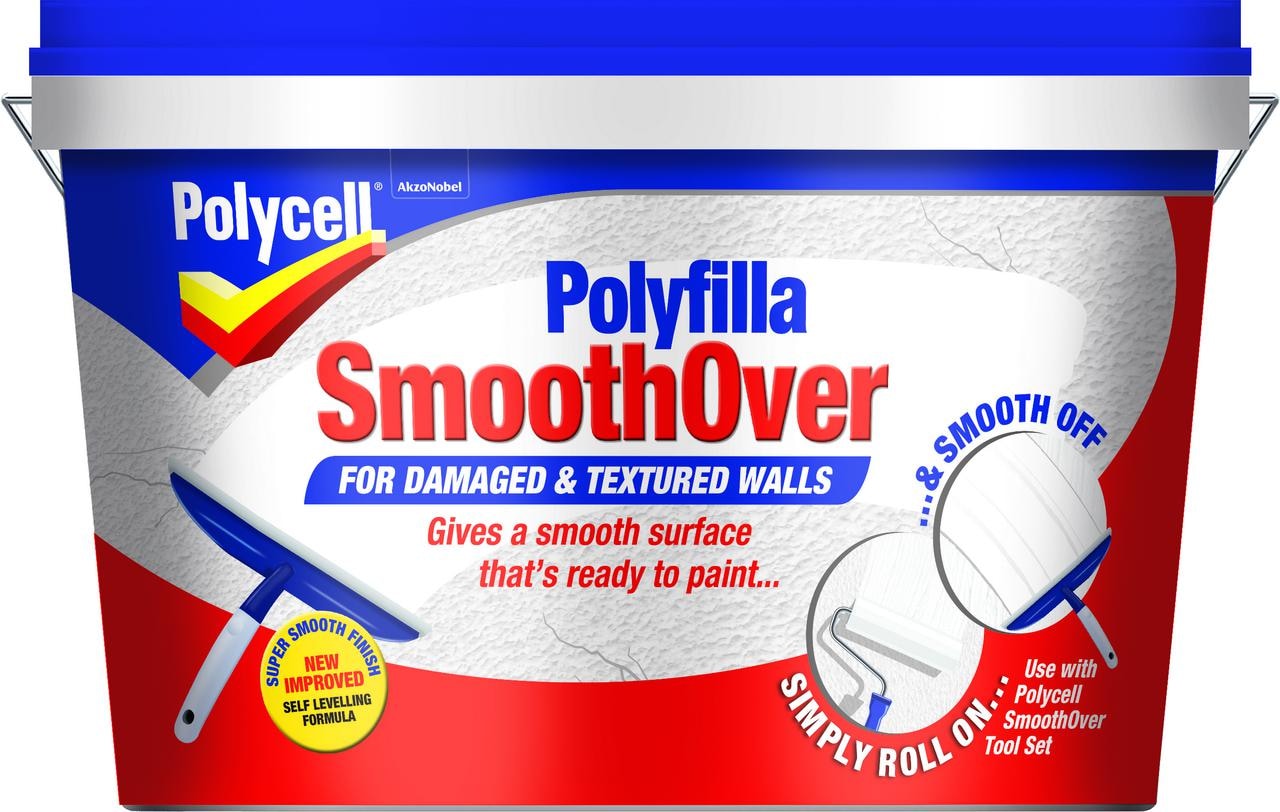
Polycell Polyfilla SmoothOver for Damaged and Textured Walls
Gives a smooth surface that’s ready to paint….
Your Measurements:
Amount Needed:
For the best result we recommend to use
{coatAmount} for {productTitle}
-
Dries in 24 hours (depending on conditions)
-
For textured surfaces on plaster, plasterboard or painted masonry surfaces and other textured backgrounds
-
Use indoors
-
Coverage 2.5 litres will cover up to 5m²(average layer thickness 0.5mm).
-
Drying Time 24 hours
-
Recoatable 24 hours
-
Easy use
-
Free of sanding
Product Description
Polycell Polyfilla SmoothOver for Damaged & Textured Walls is the easy way to create a perfect foundation for a great finish. Its special self-levelling formula fills between ridges and bumps and covers cracks and large areas of damage giving a smooth finish that’s ready to paint.
Application Description
HOW TO USE : 1) Stir the product well to a creamy consistency. 2) Immerse the SmoothOver Roller fully into the Polyfilla SmoothOver so that the roller is covered in product. 3) Gently roll the product out onto the wall, covering an area of about 1m². Smooth off using the SmoothOver Wiper in an arc over the surface of the product, ensuring that all texture is fully covered. 4) Continue across the wall 1m² at a time, overlapping each section to ensure an even coverage. Allow to dry. 5) Apply a second coat if needed. When surface is fully dry, lightly sand down small irregularities and tramlines for a perfectly smooth finish. 6) Your walls are now ready to decorate, don't worry if your background colour shows through, this will be covered when you decorate.
Technical & Safety Documentation
Tips & Advice
-
1. Preparing the SurfacesBEFORE YOU START : Cover furniture and carpets. Make sure the surface is clean, dry and free from loose particles and mould. Fill any holes deeper than 4mm with an appropriate Polycell Polyfilla and sand down well. Seal stains with Polycell Stain Stop. Touch in nails or screws with a suitable metal primer to avoid corrosion. Scrape off any high peaks from the textured surface with a pallet knife.
-
2. After useAFTER USE - Remove excess product from tools before washing with warm water in a sealed container like a bucket or tub. Dispose Responsibly- Settle Solids- Let solids settle at the bottom of the container. Pour off clear water for reuse or disposal. Disposal- Let remaining solids dry fully before disposing of them as solid waste. Do not flush paint down the drain, including when cleaning painting tools
-
3. StoringStoring & Responsible Disposal Do not use or store in extreme temperatures and protect from damp & frost. Reuse, Recycle, or Donate- Whenever possible, reuse, recycle, or donate leftover paint. Find local services at recyclenow.com. If no Community RePaint service is nearby, consider advertising paint locally—many good causes need it to brighten community spaces. Dispose Responsibly- Never pour paint or wastewater down drains or sinks. Follow instructions at recyclenow.com to recycle empty packs. Reuse Roller Cages- Remove sleeves and store cages in a dry, dust-free place. Dispose of Unusable brushes and Sleeves- If brushes or sleeves cannot be cleaned or reused, dispose of them in general waste to avoid recycling issues. Paint Wash Water- Collect wash water in a container; don’t pour it into drains or on the ground. Let solids settle, pour off clear water for reuse or disposal, and let solids dry before disposing as solid waste. Do not flush paint down drains, including when cleaning tools.
How much paint do I need?
Measure the height and length of the surface you want to paint (in metres or centimetres).

Your Measurements:
{{!-- This value will be injected with JavaScript --}}
Amount needed:
{{!-- This value will be injected with JavaScript --}}
Actual coverage will depend on the conditions of the surface. If the colour change is strong, more coats may be required.