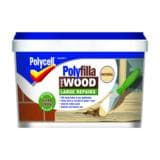
Polycell Polyfilla for Wood Large Repairs
This two-component formulation provides strength and durability and is suitable for filling damage caused by decay and wet rot when used with Polycell Polyfilla for Wood Hardener
Your Measurements:
Amount Needed:
For the best result we recommend to use
{coatAmount} for {productTitle}
-
Convenient 1:1 mixing ratio
-
Can be painted, stained or varnished in under 1 hour
-
Easy to sand finish that can be drilled, screwed, planed, carved or filed
-
Ultimate weatherproof performance
-
Quick drying low odour formulation
-
Will not shrink or crack
-
Exterior and interior formulation that flexes with the wood
-
Drying Time 30 minutes
-
Recoatable 45 minutes
-
Big holes
-
Quickdry
Product Description
Polycell Polyfilla for Wood Large Repairs is a tough, exterior and interior woodfiller for major wood repairs that can be painted, stained or varnished in under 1 hour. The two-component formulation provides strength and durability and is suitable for filling damage caused by decay and wet rot when used with Polycell Polyfilla for Wood Hardener.
Application Description
HOW TO USE : 1) Remove the inner Tub B from the main Tub A. 2) Take an even amount out of each tub and mix the two components well until a uniform colour is formed. 3) Do nor prepare more filler than can be used in 10 minutes. 4) Press and work the filler well into the repair and smooth off with a filling knife. 5) After approx. 30 minutes, the filler can be carved or shaped with a modelling knife. After approx. 45 minutes it can be sanded, planed or filed. 6) Finish with a paint, stain or varnish.
Note: The filler may stain or varnish differently to the surrounding wood. To ensure a satisfactory result we recommend using Natural for staining or varnishing and White for painting. Fill a small test area first to ensure acceptable appearance. Do not use with wood dye.
Note: The filler may stain or varnish differently to the surrounding wood. To ensure a satisfactory result we recommend using Natural for staining or varnishing and White for painting. Fill a small test area first to ensure acceptable appearance. Do not use with wood dye.
Technical & Safety Documentation
Tips & Advice
-
1. Preparing the SurfacesBEFORE USE : Ensure the area to be filled is clean and free of loose material. For repairs to decayed and rotten wood, use Polycell Polyfilla for Wood Hardener prior to filling, following the on pack instructions.
WHERE TO USE : Suitable for all exterior and interior wood repairs but especially damages over 5mm deep and for repairs on decayed or rotten wood. Usage areas include windows, window frames, sills, doors, door frames, floors, joinery, interior and garden furniture and repairs to sheds. Do not use under water or on permanently wet areas. Not suitable for filling gaps between floor boards. For general and minor repairs use Polycell Polyfilla for Wood General Repairs. -
2. After useAFTER USE - Replace membranes and lid, dispose of any mixed, unused filler and remove excess product from tools before cleaning in warm water in a sealed container like a bucket or tub. Dispose Responsibly- Settle Solids- Let solids settle at the bottom of the container. Pour off clear water for reuse or disposal. Disposal- Let remaining solids dry fully before disposing of them as solid waste. Do not flush paint down the drain, including when cleaning painting tools
-
3. StoringStoring & Responsible Disposal Do not use or store in extreme temperatures and protect from damp & frost. Reuse, Recycle, or Donate- Whenever possible, reuse, recycle, or donate leftover paint. Find local services at recyclenow.com. If no Community RePaint service is nearby, consider advertising paint locally—many good causes need it to brighten community spaces. Dispose Responsibly- Never pour paint or wastewater down drains or sinks. Follow instructions at recyclenow.com to recycle empty packs. Reuse Roller Cages- Remove sleeves and store cages in a dry, dust-free place. Dispose of Unusable brushes and Sleeves- If brushes or sleeves cannot be cleaned or reused, dispose of them in general waste to avoid recycling issues. Paint Wash Water- Collect wash water in a container; don’t pour it into drains or on the ground. Let solids settle, pour off clear water for reuse or disposal, and let solids dry before disposing as solid waste. Do not flush paint down drains, including when cleaning tools.
How much paint do I need?
Measure the height and length of the surface you want to paint (in metres or centimetres).

Your Measurements:
{{!-- This value will be injected with JavaScript --}}
Amount needed:
{{!-- This value will be injected with JavaScript --}}
Actual coverage will depend on the conditions of the surface. If the colour change is strong, more coats may be required.