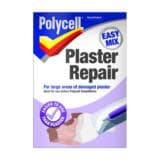
Polycell Plaster Repair Polyfilla - Powder
Lightweight,anti-slump formula for repairing damaged plaster.Ideal for use before Polycell Smoothover
Your Measurements:
Amount Needed:
For the best result we recommend to use
{coatAmount} for {productTitle}
-
Dries in 24 hours (depending on conditions)
-
Use indoors for plaster, plasterboard and masonry
-
Ideal for repairing large areas up to 50mm deep
-
Drying Time Dry in 24 hours (depending on conditions)
-
Recoatable Dry in 24 hours (depending on conditions)
-
Easy sand
-
Easy use
Product Description
Polycell Plaster Repair is ideal for repairing large areas of damaged plaster. Specially ready mixed to a light consistency, it's much easier to apply and smooth out than ordinary plaster. It gives a smooth 'ready to decorate' finish to all masonry surfaces and will not slump, shrink or crack.
Application Description
HOW TO USE : 1) Stir to a smooth consistency. 2) Apply with a filling tool: a filling knife, trowel or float, with random sweeping strokes. 3) Gently smooth off with a clean, wet tool, cleaning and wetting between strokes. Alternatively use a length of straight wooden batten. 4) Once surface is firm but before it dries hard, re-wet and polish with a clean tool for a smooth finish. 5) Allow at least 24 hours to dry (several days for deeper repairs). Sand smooth if necessary.
Technical & Safety Documentation
Tips & Advice
-
1. Preparing the SurfacesBEFORE USE : Ensure surface is sound and free of loose material. Touch in nails and screw heads with a suitable metal primer and ensure all wiring is insulated and isolated.
-
2. After useAFTER USE - Store any unused powder in dry conditions. Remove excess filler from tools before cleaning in warm water in a sealed container like a bucket or tub. Dispose Responsibly- Settle Solids- Let solids settle at the bottom of the container. Pour off clear water for reuse or disposal. Disposal- Let remaining solids dry fully before disposing of them as solid waste. Do not flush paint down the drain, including when cleaning painting tools
-
3. StoringStoring & Responsible Disposal Do not use or store in extreme temperatures and protect from damp & frost. Reuse, Recycle, or Donate- Whenever possible, reuse, recycle, or donate leftover paint. Find local services at recyclenow.com. If no Community RePaint service is nearby, consider advertising paint locally—many good causes need it to brighten community spaces. Dispose Responsibly- Never pour paint or wastewater down drains or sinks. Follow instructions at recyclenow.com to recycle empty packs. Reuse Roller Cages- Remove sleeves and store cages in a dry, dust-free place. Dispose of Unusable brushes and Sleeves- If brushes or sleeves cannot be cleaned or reused, dispose of them in general waste to avoid recycling issues. Paint Wash Water- Collect wash water in a container; don’t pour it into drains or on the ground. Let solids settle, pour off clear water for reuse or disposal, and let solids dry before disposing as solid waste. Do not flush paint down drains, including when cleaning tools.
How much paint do I need?
Measure the height and length of the surface you want to paint (in metres or centimetres).

Your Measurements:
{{!-- This value will be injected with JavaScript --}}
Amount needed:
{{!-- This value will be injected with JavaScript --}}
Actual coverage will depend on the conditions of the surface. If the colour change is strong, more coats may be required.