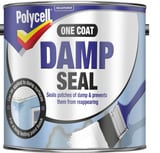
Polycell One Coat Damp Seal
Seals patches of damp & prevents them from reappearing
Your Measurements:
Amount Needed:
For the best result we recommend to use
{coatAmount} for {productTitle}
-
Seals patches of damp & prevents them from reappearing
-
Can be applied to damp surfaces
-
For a longer lasting paint finish
-
Drying Time Touch dry in 4 hours (depending on conditions). Allow to dry fully before overcoating (overnight)
-
Recoatable Overnight
-
Easy use
Product Description
Polycell One Coat Damp Seal has been specially formulated to seal patches of penetrating damp on interior walls and ceilings in just one coat, preventing them from showing through and spoiling decorations. Polycell Damp Seal has a matt white finish that can be decorated if required.
Application Description
HOW TO USE : 1) Allow new plaster to dry for at least 1 to 2 weeks before using this product. 2) Stir the product well. Do not thin. 3) Apply the product generously with a brush or roller to damp but not saturated surfaces working well over the affected area and a wide surrounding area, while avoiding runs. 4) Avoid splashing on polystyrene tiles or any plastic materials. 5) Allow to dry fully before overcoating (overnight). 6) Treated surfaces are now ready to decorate. 7) Drying of wall coverings, especially vinyl coverings may be slowed.
Technical & Safety Documentation
Tips & Advice
-
1. Preparing the SurfacesCover furniture and carpets. Make sure the surface is clean, dry and free from loose particles and mould. Remove any wallpaper or loose paint. Fill holes or cracks with an appropriate Polycell Polyfilla and sand down well. Polycell Damp Seal is not a cure for damp, which should always be trated at source before applying, and is not suitable for use against rising damp. Polycell Damp Seal should not be used at ground level, where efflorescent salts are present, or where condensation is a problem.
-
2. After useCleaning After Final Use- Clean brushes and rollers immediately after final use to reuse them for future projects, saving you money and reducing waste. Cleaning Steps- 1. Remove Excess Paint- Scrape off leftover paint into a container for reuse. 2. Use Brush Cleaner- Use Polycell Brush Cleaner to clean brushes and rollers. 3. Reuse Brush Cleaner- Allow the paint solids to settle and reuse the cleaner by pouring the clear liquid into another container. 4. Dry Naturally- Let tools air-dry and store in a dry, dust-free area. Dispose Responsibly- Dispose of the remaining solids and used brush cleaner at a hazardous waste facility. Do not pour any solvent-based paint, brush cleaner or washings down the drain or onto the ground. Do not flush paint down the drain, including when cleaning painting tools
-
3. StoringStoring & Responsible Disposal Do not use or store paint in extreme temperatures and protect from frost. Whenever possible, reuse, recycle, or donate leftover paint. Find local services at recyclenow.com. If no Community RePaint service is nearby, consider advertising paint locally—many good causes need it to brighten community spaces. Dispose Responsibly- Never pour paint or waste washings down drains or sinks. Follow instructions at recyclenow.com to recycle empty packs. Reuse Roller Cages- Remove sleeves and store cages in a dry, dust-free place. If brushes or sleeves cannot be cleaned or reused, dispose of them in general waste to avoid recycling issues. Paint Washings- Collect used brush cleaner in a container; don't pour it into drains or on the ground. Let solids settle, pour off clear liquid into another container for reuse or disposal. Dispose of remaining solids and used cleaner at a hazardous waste facility. Do not flush paint down drains, including when cleaning tools.
How much paint do I need?
Measure the height and length of the surface you want to paint (in metres or centimetres).

Your Measurements:
{{!-- This value will be injected with JavaScript --}}
Amount needed:
{{!-- This value will be injected with JavaScript --}}
Actual coverage will depend on the conditions of the surface. If the colour change is strong, more coats may be required.